
Seeing the Sourlands: Late Fall/Early Winter
By Jim Amon
In spring, the woodland wildflowers beguile us with their delicate beauty; in summer, the meadows are full of flowers, butterflies, and bees; in fall, the autumnal colors dazzle us. But what happens in late fall and early winter when these spectacular shows have passed? Is everything dull then? Is there little reason to visit meadows and forests once the leaves have fallen? I still make those visits when I can because I like to think of the landscape at that time of year as not boring but subtle. This period features shades of brown, black, and gray; it is a period when texture is one of the dominant elements in the landscape. At this time, the trees, shrubs, and, often even the flowers, uncover their structure, sometimes referred to as their bones.
I have good news for you: the natural world never has an off-season.
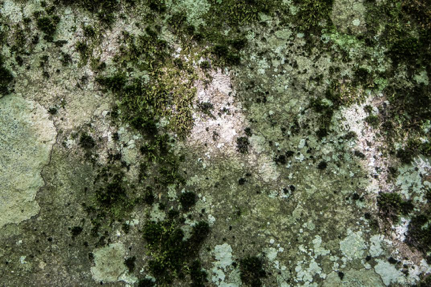
Lichen and moss
Form and texture in this photo result from the splotches of lichen and the flecks of moss on a rock face. I am frequently asked how lichen and mosses differ, and the main difference is that mosses are plants with little stems and leaves, but lichens are not plants. Lichens are compound organisms made up of an alga and a fungus, or sometimes two different fungi.
Mosses are always green, and lichens are several different colors in addition to green. In the photo above, the whitish and grayish blobs are lichens, and the black dots are moss—the moss has lost color because it has not had access to water during this freezing period.
Neither lichens nor mosses have roots, and neither produces flowers.
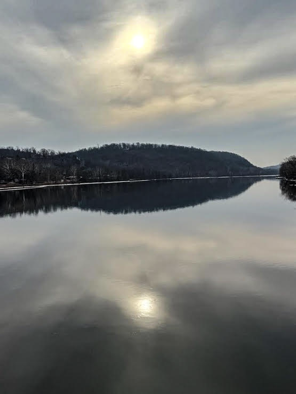
Morning sun over the Delaware River
Two Suns! Did they warm me? No, it was a cold January morning when I walked my dog across the Delaware River, and I was chilled. The sun in the sky was a classic winter sun—shrouded in clouds, incapable of providing any real warmth. Nor, it is safe to say, did the reflected sun provide warmth—except I was warmed a bit from chuckling at my own joke about there being two suns. I welcomed any warmth I could find at that time. I also enjoyed the sky’s shading of blues and yellows, reflected in the river.
It is hard, when you are exposed to the wind off the river and to temperatures below freezing, to remember that in January, the earth is closer to the sun than at any other time of year.
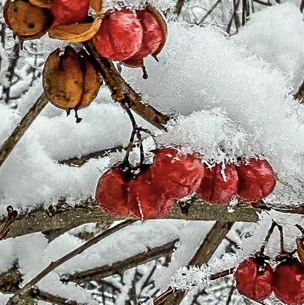
Oriental bittersweet
I had a real adventure with this photo. After downloading it, I wasn’t sure where I took it, but with the aging fruit and the snow, I thought it was pretty and that it nicely depicted winter.
At first, I thought that it must be a vine, and Japanese honeysuckle seemed possible. I did some research and found that Japanese honeysuckle doesn’t have red fruit. I did, however, find something very interesting about Japanese honeysuckle during my research, and I am compelled to pass it on. It is widely known that female birds select a mate partly based on the brightness of the male’s coloring. The brightest, reddest male cardinal gets all the female cardinals. The female concludes that brightness depicts strength and good health—making the brightly colored male birds suitable fathers for her brood. The berries of Japanese honeysuckle contain a pigment that brightens the feathers of birds that eat them, so male birds that may not be the fittest of their flock look like they are. This weakens the gene pool.
Then I thought it must be a crabapple. Crabapples are wonderful for many reasons; in spring, they are covered with flowers that are beautiful, and that feed many pollinating insects. By late summer, their beautiful fruits (sometimes yellow but more often red) appear and last into winter, feeding many species of birds and small mammals. In autumn, the tree’s leaves turn a beautiful yellow or orange. Aside from their taste (very, very tart), what’s not to like about crabapples? But I wasn’t convinced that this was a photo of a crabapple.
Finally, I concluded that this was a picture of Oriental bittersweet fruit. I found the source of the photo and saw that the plant was clearly a vine, with leaf buds placed alternately on the stem, and with a few of the berries retaining their orange bud cover. I was sorry to decide on Oriental bittersweet because it is one of the worst of the alien invasive plants. It grows easily in almost any habitat with some sunlight, it grows very rapidly, and a single vine can reach a hundred feet in length. Also, it very often kills native plants around it that are less aggressive growers. It can become so heavy that it can bring down a good-sized tree. It is very attractive, and birds eat the fruit when other food sources are unavailable, but the fruit contains very little nourishment. This is not a suitable plant for the Sourlands.
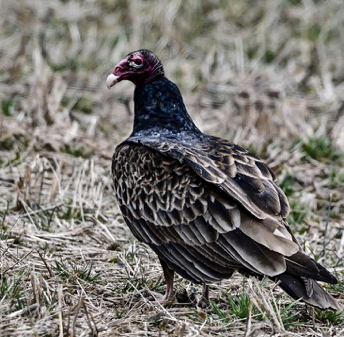
Turkey vulture
Have you thanked a vulture lately? Turkey vultures, along with their cousins, black vultures, deserve our gratitude. They remove a terrible brew of toxic bacteria and viruses from our landscape. Carrion contains viruses like West Nile and rabies, and can contain many types of bacteria. Further, the vultures rid the landscape of the foul odor that begins emitting shortly after an animal dies. All those toxins and foul odors simply become part of a vulture’s meal.
Vultures are able to eat disease-ridden carrion because they have acid in their stomachs that is stronger than battery acid. This acid not only neutralizes the diseases, but it is so strong that it dissolves the bones of the dead animals, allowing the vultures to completely consume the rotting bodies.
We seldom get to see the splendid pattern and color of a vulture’s feathers, but they reflect the season’s beauty perfectly.
Thank you, vultures!
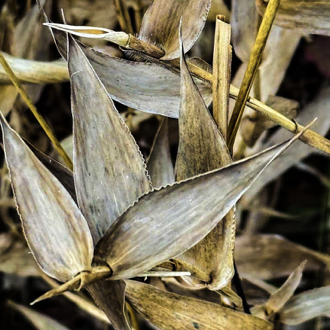
Deer tongue grass
In the opening paragraph, I said that the beauty of nature at this time of year is in texture, form, and in subtle shades of brown and gray. This photo of deer tongue grass illustrates those traits.
Deer tongue grass is especially versatile about reproduction. In spring, it produces a spike with flowers that are pollinated by insects. In addition, tucked beneath a leaf sheath, is a flower-like organism that never opens but is self-pollinated and produces a viable seed. And finally, deer tongue grass reproduces asexually by sending rhizomes beneath the ground that send up new plants.
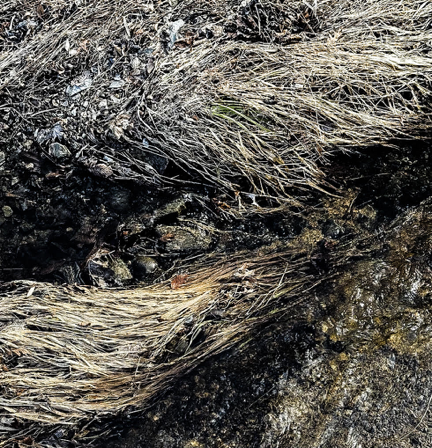
Grasses flattened by high water in the Stony Brook
Browns, grays, blacks—highlighted by the touch of red—and great texture.