
Winter Walk (Originally Published in 2020)
By Jim Amon
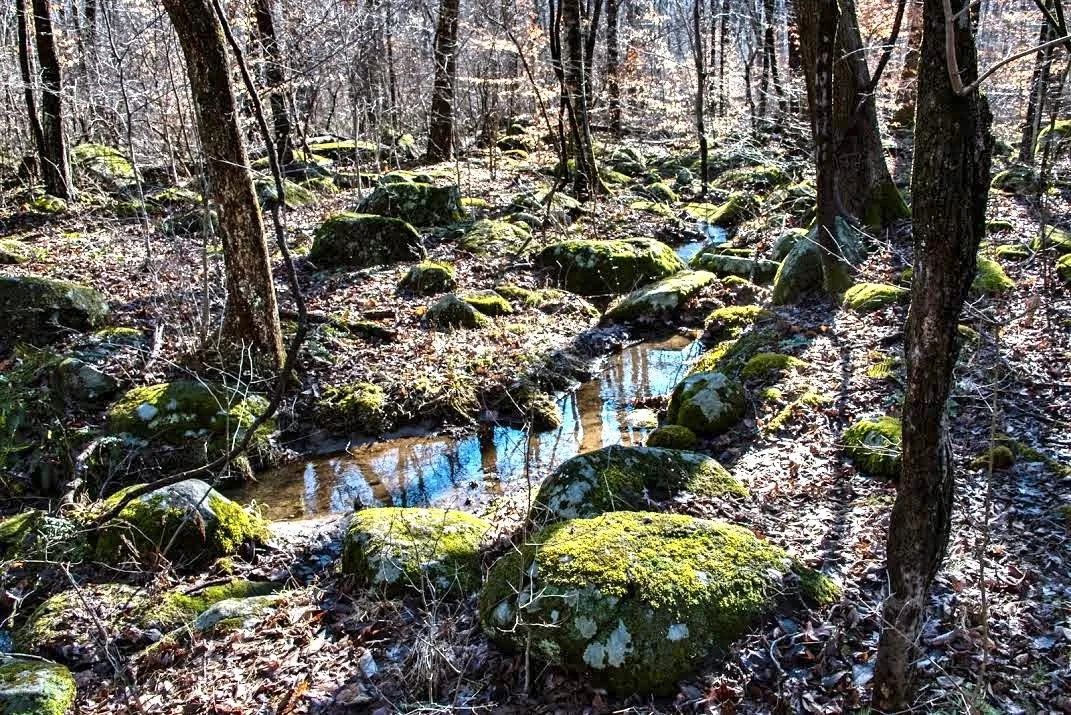
The boulders along this stream corridor are softened by the moss covering them. If you squint and let your imagination go, they look like a large family of animals—big papas, little babies, and medium-sized mammas—hunkered down for the winter.
I decided to take a walk in the woods on a Sunday morning in January, looking closely at the landscape and noting my thoughts and what I saw. It had rained most of the day before, so the path and the forest floor were quite wet.
The first thing that I noticed was the stillness. There was no wind when I started, so not only was there no sound, there was no movement. About fifteen minutes into the walk a red-bellied woodpecker began calling and banging away at a tree. This bird, or its companions, was the soundtrack for the rest of the walk; everywhere I went I could hear it—or them. Red-bellied woodpeckers, Carolina wrens, and tufted titmice are the loudest voices in the winter woods. The quiet was later broken by the sound of a light airplane flying by. And that was truly the end of silence on my winter walk because small airplanes continued to fly over periodically. I wonder how many small airplane pilots are even aware that a joyous flight for them means an audible intrusion for anyone who is outside near their flight path.
Predictably, boulders were strewn everywhere alongside my Sourlands path, and virtually every boulder and stone was decorated with lichen or moss, or both. The colors of the lichen were mostly gray-green and fit perfectly with the muted colors of a winter forest. The brighter green color of the mosses added a dash of cheer to the landscape.
At about 10:30 AM a slight breeze visited some very specific locations in the forest, and here and there one leaf on a beech full of leaves began to dance around like a person who has just hit his thumb with a hammer. Every other leaf on the beeches remained motionless, adding a madcap quality to the ones so violently shaking.
I was surprised by the number of limbs and small branches that had fallen on the path. At first, I began to wonder if more branches fall in winter than in summer, but that is a question that I don’t know how to answer. What I did come to understand, however, is that the forest makes adjustments year around; many are so slow they are barely noticeable, but others occur rapidly. Plants grow bigger or die. New plants appear. Limbs and branches fall from trees regularly. I came upon a place where a giant American beech was blown down about ten years ago and saw that it had created a gap in the canopy in which fifteen young beech saplings were racing to fill. One or two of them will succeed; the others will fail to get enough sunlight to survive. They will eventually fall to the forest floor and begin decomposing, creating nutrients for the ones that succeeded.
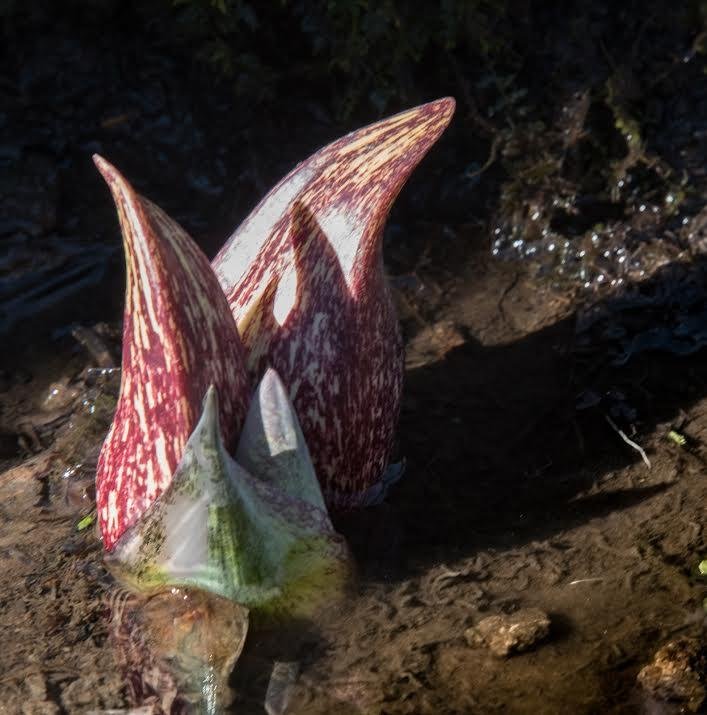
Skunk cabbage was coming up in muddy areas along a little tributary to the Stony Brook. I took its appearance as a sign that however short the days are now and however cold the temperature, spring will come. It is well known that skunk cabbage generates heat that allows it to poke through frozen soil. This heat protects the spadix (a type of flower enclosed in thick leaf-like bracts—shown here) from freezing temperatures. It may be well known, but however many times I have put my finger inside an emerging spadix, I have failed to feel any heat.
I saw my walk through the woods as being like a walk through a sculpture garden. The strongest image was of trees of all sizes, with different textured and different colored bark, in a rigorously vertical pattern that was occasionally interrupted by trees that arched to the ground, often pinned by a neighboring tree’s fall, or by a few trees that remained more or less upright but were slanted because their fall had been interrupted when their limbs locked with other tree limbs. Upturned root balls from trees that had fallen years before had root stubs sticking in varying directions and seemed especially like sculpture. I came upon a vernal pond whose calm water reflected the trees around it, creating the appearance of upright trees and upside-down trees joined at the stump. An old grapevine was now attached to its host tree only at the crown, and the rest of the vine displayed acrobatic twists, loops, and changes of direction. These visions are present in summer but the abundant foliage makes them less prominent.
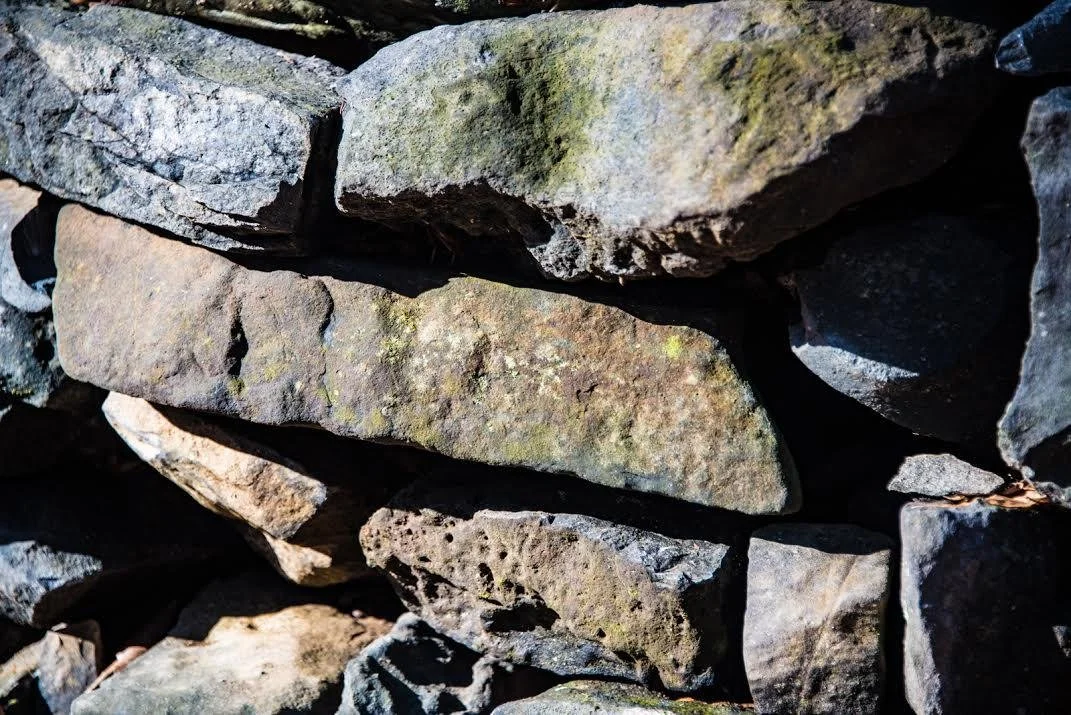
I have looked at aerial photographs of the Sourlands from the 1930s and seen that only a few farms existed at that time. But those photographs also show abandoned fields with brush beginning to come in, indicating that earlier there were many more farms. When farms were common here the farmers cleared the stones from the fields and made walls from them. The walls usually mark either an old property line or the boundary between two fields or pastures. Sometimes I can see differences in the trees on either side of a wall because one side may have been abandoned earlier than the other. If the walls are made of large stones only, it was probably a wall defining a pasture because there would have been no need to remove small stones from a pasture. A crop field, however, could not be plowed if smaller stones were left, so a wall with both large and small stones separated crop fields. The one partially shown above was probably a pasture wall. Either way, these remnant agricultural structures are now pieces of sculpture in a forest.
My walk lasted for almost two and a half hours and in the end, the sun had dried the top layer of leaves on the forest floor. I was sorry to see that; when they were wet the browns and reddish browns of the leaves glistened and displayed a richer color than when they were dry.