
Owls
By Jim Amon
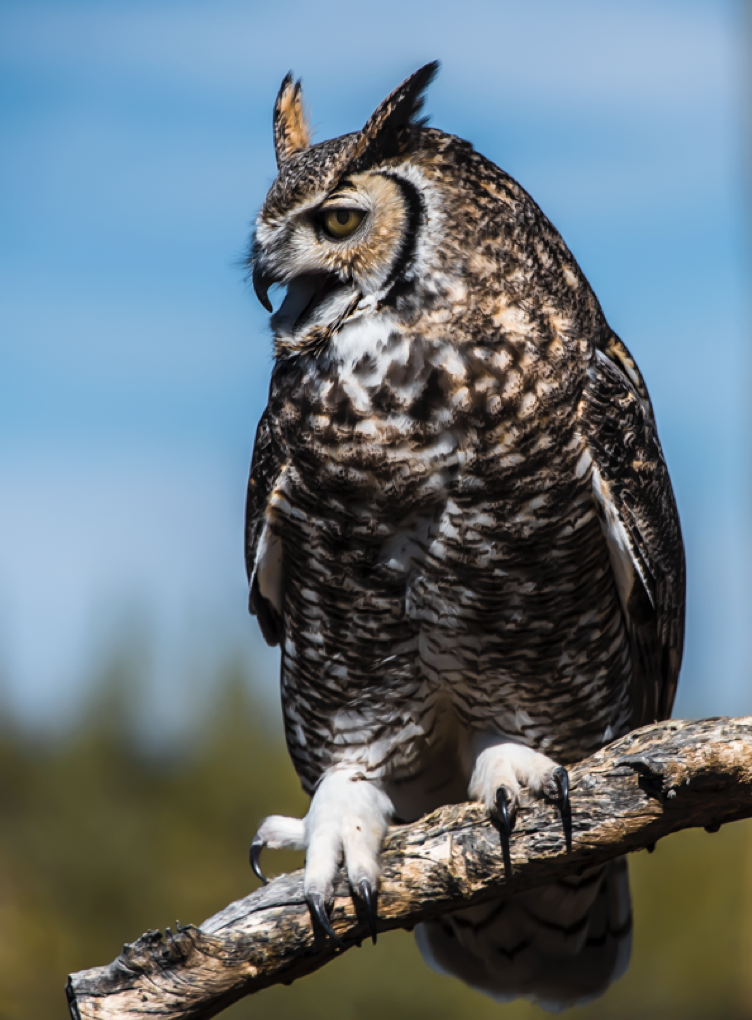
A great horned owl’s horns are actually tufts of feathers. Great horned owls are native to North and South America and live in all types of habitats except the desert and the arctic. They are fierce hunters and, while their diet is mostly mice and other small rodents, they can kill and eat ospreys, peregrine falcons and many species of smaller owls. No owl species is known to construct its own nest. Great horned owls will use abandoned nests of crows, squirrels, other raptors or herons.
I have been walking in the Sourlands for decades but I have never seen an owl there. (I took the photos in this essay somewhere else.) Many environmental groups offer evening “owl prowls” to their members, often in the Sourlands, and those hikes always tweak my interest, but I have never gone. I have always opted for a glass of wine and a nice dinner. But I find owls interesting and I am not the only one. Owls have fascinated humans in all cultures for millennia. In some cultures they have been seen as benevolent and wise creatures, but more often these adept killers who strike silently by night have been seen as omens of death, witchcraft and pestilence. It seems to have been the ancient Greeks who first though of owls as wise. They used an owl as the symbol for their goddess of wisdom, Athena. A striking example of seeing owls as evil is that well into the 19 th century many Europeans who wanted to ward off evil killed barn owls and hung them upside down on a church or barn door. Today, the graphic beauty of stylized owls has overwhelmed any thoughts we might have of them as symbols of either good or bad. I take this as another sign that present day culture is out of touch with nature.
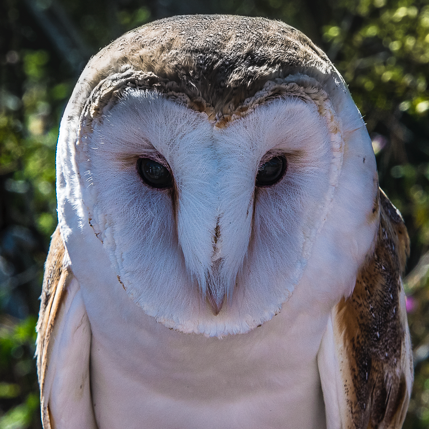
Barn owls are found on six continents and many islands, making them one of the most widespread of birds. They have one to three broods a year, laying three to eight eggs each time. The chicks, however, have a low probability of survival because of predation from raccoons, opossums, hawks, eagles and larger owls. Starvation, particularly in winter, also takes a heavy toll. Worldwide, their population is more or less steady—increasing in some areas, decreasing in others and stable in some. The bird shown here is probably a male because the females are more richly colored and have spotted breasts.
There is an extensive bibliography on owls; they are such interesting animals that they have attracted a lot of scientific study. In this essay I will touch on three things about owls that particularly interest me—their sight, their hearing and their ability to fly silently.
Like humans, both eyes are on the front of owls’ faces, giving them binocular vision, which allows them to see objects in three dimensions. Owls’ eyes are unusually large for such a relatively small animal and their pupils open wider than human eyes. Further, their eyes are not balls; they are cone-shaped, made up of rod-like receptors that are very good at capturing light. Therefore, more light comes into an owl’s eyes. Once the light reaches the back of an owl’s eye, it hits a mirror-like structure that reflects the light back to the rod-like receptors in the eye, giving owls a second chance to capture light. The downside to having rod-like receptors is that they are not good at transmitting color, so owls have limited color range in their vision. Another consequence of having eyes with rod-like receptors is that owl eyes cannot be moved or rolled around in their heads. Owls make up for this problem by being able to move their heads over two hundred and seventy degrees, as compared to humans who can move one hundred and eighty degrees, and owls can almost turn their heads upside down.
Owls rely upon their hearing as much as or more than their sight while hunting prey. They have the ability to locate prey in the near dark and sometimes when it is beneath a cover of snow because of their wonderful ability to hear. One ear is slightly higher and slightly further back on their heads, meaning that sounds reach the ears at slightly different times, allowing them to locate tiny sounds more accurately.
Several things contribute to owls’ ability to fly silently. First, their wings are large relative to their body size. Great horned owls weigh about three and a half pounds and have a wingspan of up to five feet. Bald eagles weigh three times as much and only have an additional foot of wingspan. The larger wings mean that they glide more and flap less. The difference between their feathers and those of other raptors, however, is the main reason for the silent flight. Owl feathers are remarkably soft, reducing air turbulence when they fly. Further, the leading edge of their wing feathers have comb-like serrations that break up the turbulent air that usually creates a whooshing sound. A soft fringe on the wing’s trailing edge further reduces those smaller streams of air.
Owls are killers who can hear and catch a mouse under a foot of snow, or nab a squirrel in the dark of night without making a sound of approach, and then eat the entire prey animal, coughing up the indigestible parts later. So, are they a cute image for a tote bag; is there wisdom behind that big-eyed stare or are they the eyes of a professional killer?