
Musclewood
By Jim Amon
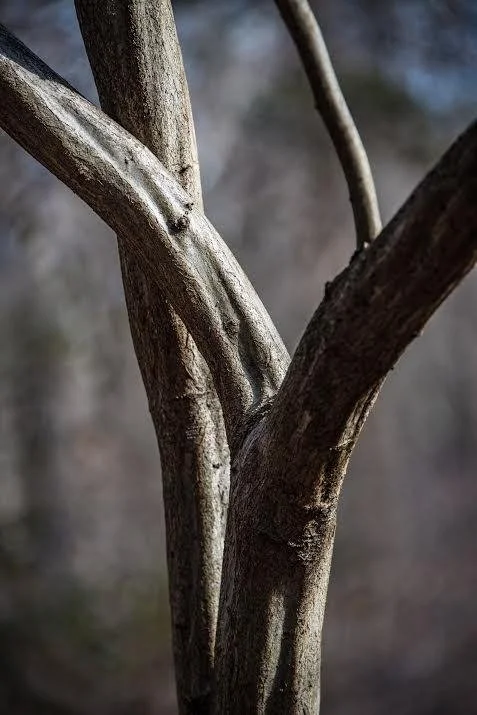
Musclewood got its common name because its trunk and branches look like well-muscled legs or arms.
This past December started with a string of gray, rainy days and I spent much of the time staying inside and reading. But it is always difficult for me to stay indoors day after day, and soon I was pacing around the house and checking the refrigerator and cupboards regularly, hoping to find a delicious little snack that I had somehow overlooked on a previous visit. Finally, I put on a sweater and a coat, topped with a brightly colored reflector to make sure that a hunter would not mistake me for a deer, and went into the Sourland forest. At first, it was hard for me to look at anything except the path because it was so muddy that each step had to be carefully considered. Soon, however, I relaxed with the confidence that my boots were going to stay watertight and with the realization that it didn’t really matter if they got muddy. Muddy boots are easily cleaned. Even after I settled into the forest, however, I had to admit to myself that in mid-December the Sourland forest is pretty much a study in grays, browns, and blacks. There were splashes of green here and there where a Christmas fern remained, or some moss brightened a log. I didn’t mind the muted colors, however, and I was delighted to see that among the grays were the trunks of one of my favorite trees, musclewood.
Muscelwood trees have many common names. They are often called American hornbeam because when polished their wood shines like a horn. (The “beam” in their name comes from the German “baum” which means tree.) Another common name is blue beech. Even though musclewood is a member of the birch, not the beech family, their blue-gray, smooth bark is reminiscent of beech bark. Sometimes, in recognition of their very dense wood, they are called Ironwood.
A fully-grown musclewood tree will only reach a height of about forty feet, spending its entire life in the understory. They are also usually slight in girth; a really old musclewood tree might have a trunk that is only fourteen inches in diameter. They are hardy, adaptable trees that can grow in any part of the forest, but prefer moist habitats in lowlands or in stream corridors.
The understory is often an overlooked layer of the forest. Most of the trees in the understory layer are saplings of the canopy trees or shrubs that have grown beyond what is usually considered to be shrub height. The oaks, hickories or maples in the canopy get the bulk of our attention. The next most obvious part of a forest is the herbaceous layer—the lovely woodland flowers, grasses, sedges, and ferns. The shrub layer claims our attention because shrubs are often right at eye level.
However unobserved they may be, understory trees have an important role in the ecology of the forest. They provide an increased layer of shade to the forest floor, making the soil moister and therefore a better habitat for mosses, ferns, and the many, many animals, bacteria and fungi that live on or in the soil. Understory plants add to the capture of carbon and to the release of oxygen that is provided by the other forest layers. Understory trees also provide important habitat and sources of food for many songbirds. Wood thrushes, whose flute-like song is a signature sound of the spring forest, nest, and forage in understory trees.
Muscelwood is one of many trees that have an interesting architecture. Think of pin oaks, whose lower branches grow downward, often making a tent around the trunk. Or think of a copse of sassafras trees that look like a group of dancers frozen in graceful undulations. Dogwood branches always turn up at the end, reminding me that optimism is more attractive than pessimism. The architecture of musclewood trees is often a result of its loss of a limb, or branch, or even of its crown. Living in the understory makes them susceptible to amputations of their parts by limbs or from entire trees falling from the canopy. The losses don’t stop musclewood trees from putting out new limbs, often at right angles from the stem, giving them a look of flexed elbows and knees.
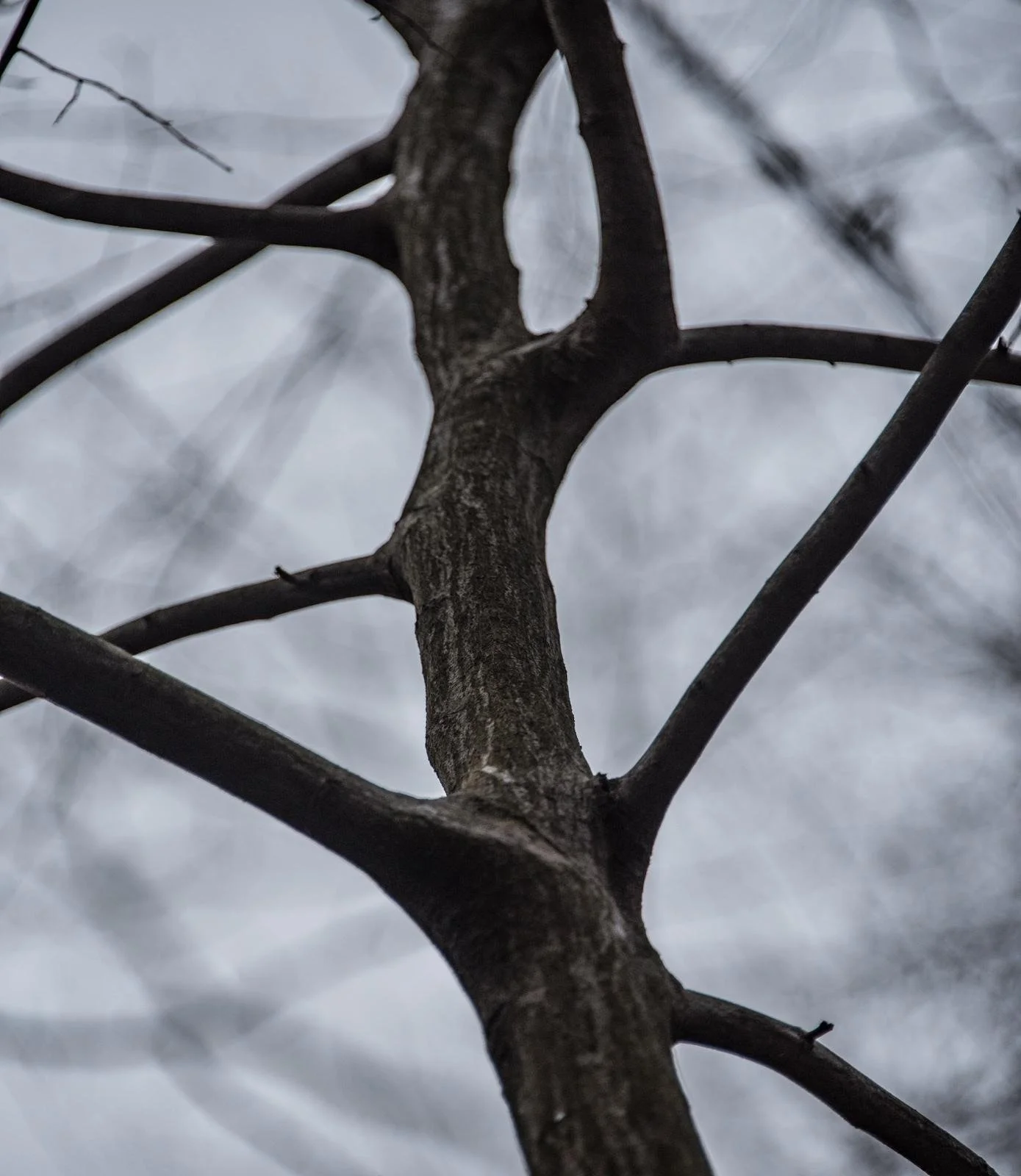
Quirky branching pattern of a musclewood tree
Tactual enjoyment of the Sourlands is unusual for me; usually, I see, hear and taste more than I touch or smell. But it is hard for me to see a musclewood tree and not reach out to touch it. Not just to touch it, but to run my hand along its smooth, fluted stem. In addition to musclewood, I sometimes like to touch boulders, and I have run my hand over the top of a moss patch and, of course, the thorns on multiflora rose often touch me—right through my pants.