
By Jim Amon
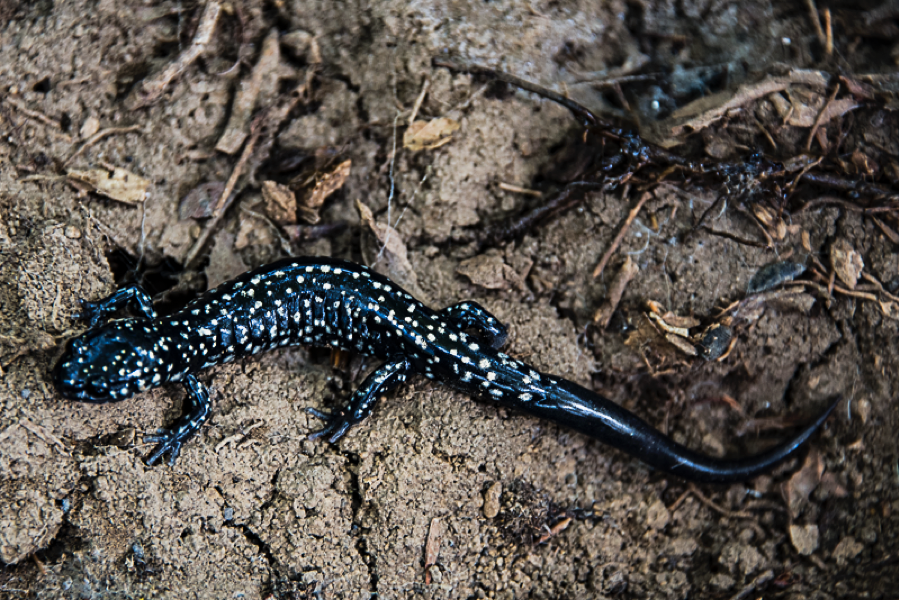
Northern slimy salamander after its covering rock has been removed.
I walked in the Sourlands on a warm October morning, turning over rocks as I went. I just wanted to see what was under them. Mostly, what I found was nothing. Twice, however, I found salamanders. One of them immediately started gyrating and was gone before I could really see it. I didn’t see it long enough or well enough to make an identification. All I know is that it was reddish in color. The other one sat still and let me take the above photo. When I got home and consulted my field guide to reptiles and amphibians, I discovered that this pretty little creature has the very not pretty name of northern slimy salamander. All salamanders are slimy; why single out this species for that pejorative name? Salamanders secrete a mucus-like substance to keep their skin moist, which helps keep it permeable, and that is important because they breathe through it. Many species do not even have lungs. The mucus-like substance of the northern slimy salamander is a little different from the secretions of other salamanders because it hardens into a glue-like substance. If you get some on your hand, or if a predator gets some on its mouth, it is very hard to remove. After reading that, I was glad that I had gently replaced the rock after I took this picture instead of trying to pick it up.
What were salamanders doing under rocks, I wondered, when they have the entire lovely woodland to enjoy? It turns out that there is no joy for salamanders to walk around in the woods on warm days. They stay under rocks or fallen logs during the day because being out in warm air would dry them out, making the skin less permeable and effectively suffocating them. They venture out at night and hunt for worms, slugs, snails, insects and—for some of the larger species of salamanders—mice, frogs and other salamanders.
In one or two species, their secretion is highly toxic, so the slimy salamander is not the only species that should be left untouched. Humans don’t have to worry about being bitten by salamanders because, although they have tiny teeth and they might bite if held, their teeth are too small to harm humans and their bites are never poisonous.
All salamanders start life as eggs in water, and when they hatch, they continue to live in water as tadpoles. Some salamander species develop gills and spend their mature lives in water. Some salamander species leave the water when they mature and are terrestrial dwellers. Some of these land-based salamanders have lungs, and some breathe through their skin. Some salamanders climb trees; some do not. Some salamanders live in rocky habitats; others live in forests.
Many species of salamanders have developed distinct physical characteristics as part of their adaptation to different habitats. While most salamanders have four legs, the aquatic salamanders usually have front legs only. Some of them have a prehensile tail. The tree climbers have plate-like webbed feet. Rock-dwelling salamanders have shorter toes—and sometimes more toes—than forest dwellers.
If a salamander loses its tail or a limb to a predator, it can grow a replacement. It can even regenerate some of its internal organs if they become damaged. This is a great advantage for a small, otherwise defenseless, animal—if a predator bites off a limb, simply grow another one. They are particularly good at regenerating their tails, growing one after another, each one as good as the last, if necessary.
This ability to regenerate is shared by all animals, including, to a more limited extent, humans. In humans, the most obvious example of regeneration is our skin, but it also occurs to a greater or a lesser extent in many other human organs or tissues. Finger tip regeneration in children less than ten years old, and liver regeneration are also examples of regeneration in humans. Research is ongoing on this topic.
There has been a peculiar human attitude toward salamanders. Two of my favorite responses are from ancient Rome and more modern-day Slovenia. Pliny the Elder, a Roman naturalist and philosopher, said, “A salamander is so cold that it puts out fire on contact. It vomits from its mouth a milky fluid; if the fluid touches any part of a human body, it causes all the hair to fall off, and the skin to change color and break out in a rash.”
A Slovenian weekly paper published an article in 1995 publicizing a salamander brandy. It recommended putting some live salamanders into a barrel with fermenting fruit and reported that the resulting brew is a hallucinogen that also causes extreme sexual arousal.