
The Moon
By Jim Amon
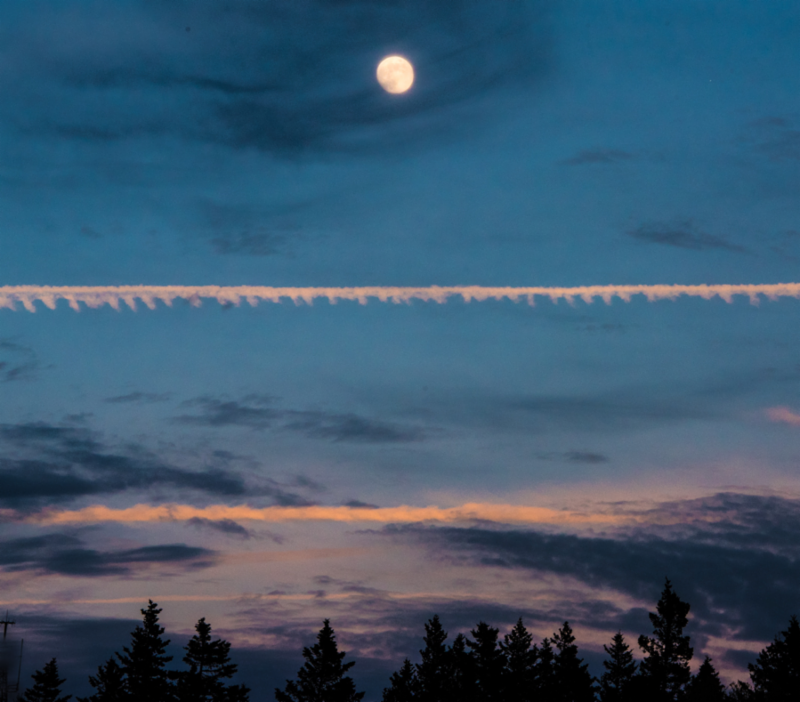
Moon and contrail
Both my wife and one of my daughters read an earlier draft of this essay and advised me that it didn’t really have anything to do with the Sourlands. All of my other essays have focused on a plant, an animal or an ecological process in the Sourlands. But, even though the Moon is 238,900 miles above the Sourlands, I think that it is an important part of the landscape and deserves it place in this series. I hope that you agree with me.
About four and a half billion years ago, shortly after the Earth was formed, scientists believe that an asteroid crashed into the Earth, loosening a huge mass of material that became the Moon. (Asteroids are the size of minor planets.) Like Earth, the Moon was highly volatile until about a hundred million years ago. Volcanic eruptions sent oceans of lava across its surface. There is evidence that volcanic activity continued at a diminishing rate until about ten million years ago, but as the Moon’s core cooled volcanic eruptions became less frequent and less violent. Meteorites and asteroids slammed into the Moon and meteorites still do. (A meteorite is much smaller that an asteroid; it is an object that has not been burned up by the atmosphere. Meteors become incinerated by the atmosphere and never reach Earth’s surface. Shooting stars are meteors.) The Moon does not have an atmosphere so meteorites still reach the Moon’s surface with some frequency. In fact, one of the concerns that NASA scientists had about landing people on the Moon was that a meteorite could hit them.
Scientists are not sure about the Moon’s core, but they believe that it is a liquid or soft iron, surrounded by a hardened iron, covered by a crust of rock. Much of the rock crust is covered with sand-like ground up stones, the result of the pounding of the Moon’s surface by meteorites. The dust on the surface is stable because there is no water to erode it and, without an atmosphere, there are no winds. The footprints that astronaut Neil Armstrong left when he walked on the Moon are as clear today as they were when he made them in July, 1969.
I am interested in information about the Moon’s origin and geology, and I still thrill at the idea that humans have walked on the Moon, but right now what I want to focus on is the relationship between the Moon and the Earth. For a long time I have been dimly aware that, like the Sun, the Moon more or less rises in the east and sets in—again, more or less, depending on the time of year—the west. But I have never made much effort to look for a pattern of moonrise and moonset. I knew that sometimes it rises before the Sun has set and sometimes it doesn’t rise until many hours of night have passed.
To find a pattern, let’s go back to basics. The Earth orbits the Sun in a counterclockwise pattern, taking a year for a complete orbit. While it is orbiting it is also rotating on its axis counterclockwise, making a complete rotation every twenty-four hours, which creates the pattern of day and night. The Moon orbits the Earth in the same direction but does not rotate. Therefore the same side of the Moon is always facing Earth. The time it takes the Moon to make a complete orbit of Earth is about 27 days.
Astronomers have defined four major phases of the Moon and four minor ones, each minor alternating with a major. The phases are named in a way that is logical to astronomers but not necessarily intuitive to the layperson. When the Moon is between the Sun and the Earth none of the side that is lit by the sun is visible on Earth. Astronomers have named this the “New” Moon because they have decided that the cycle of Moon phases starts at this point. A little more than seven days later, when the right half of the Moon is lit (as seen from Earth) the Moon is said to be in its first quarter. Officially, this is not a half Moon; officially, there is no such thing as a half Moon. It is the first quarter Moon because the Moon is one fourth of the way through its major phases. Next, again a little more than seven days later, the Earth is between the Moon and the Sun so we see the Moon fully illuminated; this, of course is the full Moon. Except during eclipses the Sun, Moon and Earth do not line up in a straight line. The Moon’s orbit is above the Earth’s equator, allowing the Sun’s rays to reach it even when the Earth is between the Moon and the Sun. The next major phase is when the left side of the Moon is lit. This is the third quarter. Then we are back to the “New” Moon. It takes 29.53 days for the Moon to go through all of its phases. The minor phases are when either the right or left side of the Moon appears to be a crescent, or when they appear to be half way between a quarter Moon and a full Moon.
The time of day that the Moon rises or sets is tied to the phases. When the Moon is full the Earth is between the Sun and the Moon, and when the Sun sets the Moon rises. Each day the Moon rises a little more than fifty minutes later than it did the day before. Therefore the day after a full Moon, it rises about fifty minutes after the Sun has set. The next day it rises about one hour and forty minuets after the sunset. The time of moonrise continues at this rate until the Moon is rising and the Sun is setting simultaneously again with the next full Moon.
The idea that people behave aberrantly when the Moon is full goes back to Aristotle. He concluded that since the Moon affects tides and since the human brain is mostly water, the Moon would affect the brains of those who are “susceptible to it.” Apparently Aristotle believed that he was not “susceptible,” and he was right about himself but wrong in his general theory. No one is susceptible. There is too little water in the brain to be affected by lunar tides. His theory never the less has persisted despite the findings of study after study in modern times that have not been able to verify that the full Moon affects human behavior in any way. Crime rates do not increase. Hospitals do not admit more patients. Patients in mental institutions do not act any differently from their usual behavior. We retain a lasting impact of Aristotle’s theory, however, in our language. The Latin word for the moon is Luna, from which the words loony and lunatic are derived.