
Goldenrod
By Jim Amon
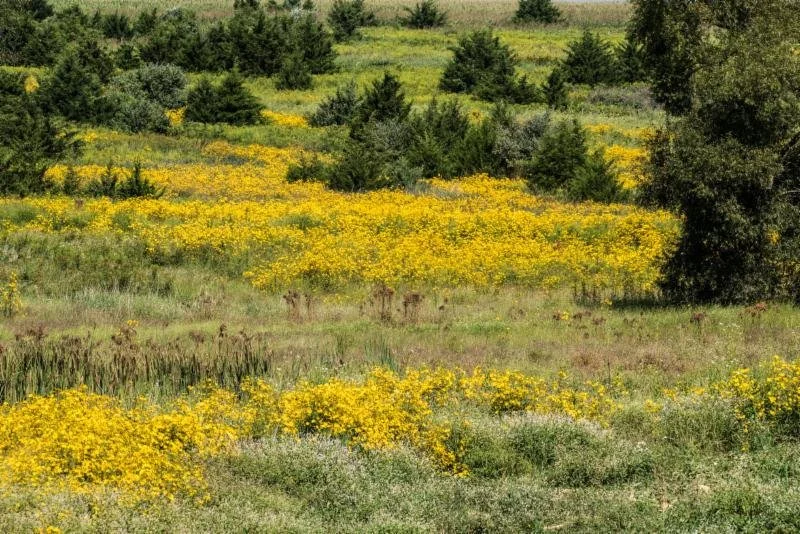
Goldenrod in an abandoned farm field.
One of the first things that I read when I started research on goldenrod is that its leaves are good to eat, the flowers are a good addition to a salad and that Native Americans ate the seeds. I knew about a nearby patch of Canada goldenrod, so I closed my computer and went out for a taste test. The leaves were somewhat minty but not very good. The flowers tasted awful. It was early September when I made this experiment so I could not find any goldenrod that was in seed. It is possible that one of the other species of goldenrod tastes better, but I decided that eating the leaves and flowers of Canada goldenrod—one of the most common of the over 100 species that are native to North America—was enough of an experiment. I also decided not to wait for seeds to ripen. After I researched some more, I read that it is the new leaves that are edible, not the weathered old September leaves that I had tried, and that the flower’s taste was “piney.” Was a “piney” taste supposed to tempt me? “Piney” as in pine sap! I don’t think so!
In addition to being promoted as a dietary item, goldenrod has long been used as an herbal medicine. Native Americans have eaten the leaves to relieve sore throats and eaten the roots to relieve headaches. Herbalists promote goldenrod as a treatment for urinary, digestive and respiratory systems. They assert that it is especially good at reducing any infection that might result from passing kidney stones.
Goldenrod is an important part of meadow ecosystems. Many kinds of caterpillars feed on it. Birds that live in meadows, like field sparrows, bluebirds and goldfinches, pick insects from goldenrod to feed their babies. A small fly, appropriately named the gall-fly, pokes a hole in the goldenrod stem and deposits her eggs in the hole. A chemical secreted with the eggs causes a round gall three to four times the size of the stem to form around the eggs. When the eggs hatch the corky inner part of the gall provides the nutrition that the larvae need to grow and mature. There is a wasp that parasitizes these larvae. Woodpeckers sometimes break open the gall and eat the larvae. Bees, wasps and butterflies take pollen and nectar from goldenrod flowers. The pollen is heavy and sticky, not subject to wind distribution, so it is a mistake to think that goldenrod causes hay fever.
Once established, goldenrod will rapidly colonize meadows. It has three qualities that help it take over. First, it is a prolific seed producer. Even more important in its propagation is that, once established, it spreads by rhizomes that grow off the root crown and send up new shoots. Third, it emits a chemical into the soil around it that discourages other plants to grow, allowing young goldenrod to have full access to sunlight and the nourishment of meadow soils. Several other plants, including black walnut trees and the Asian invasive plant, Japanese barberry, also utilize this chemical process; it is called allelopathy. Its ability to take over a field makes goldenrod a native invasive plant—it reduces plant diversity. It is also an alien invasive plant in parts of Europe and Asia.
About seven percent of goldenrod sap is rubber and Thomas A. Edison experimented with developing a goldenrod rubber that could be used commercially. His efforts were taken up anew by the United States government during World War II after the Japanese took over the areas of the south Pacific that produced rubber. Goldenrod rubber proved to be sticky and not particularly good at stretching, so it was abandoned. It interested me to read, however, that Edison’s good friend Henry Ford gave Edison a Model T car with tires made from goldenrod rubber.