
Plant Communities
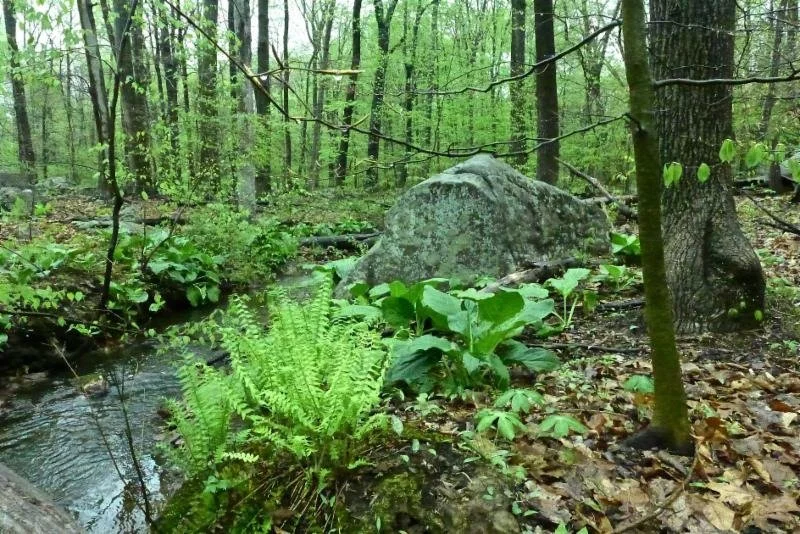
Somewhere in the Sourlands. Photo by Jim Amon
Plants do not live alone in a natural landscape, nor do they only live with others of their own kind. That is not to say that they simply appear higgledy-piggledy. They live in communities, and the make-up of those communities depends on the habitat. Is it wet? Are there deep, well-drained soils? Is it a north-facing hillside? A south-facing hillside? A sunny meadow or a shaded forest? Is it thin, clayey soil? While some plants can grow in different kinds of habitats, most of them have their own niche. The plants in the photo above prefer a moist, rich forest habitat-and the Skunk cabbage especially likes to have a lot of moisture. It is not clear from this photo, but we can assume that the Skunk cabbage shown above is growing in a little depression that collects rainwater. The Christmas fern might also be found on a well-drained hillside but would be unlikely to share the depression with the Skunk cabbage because that site is too wet.
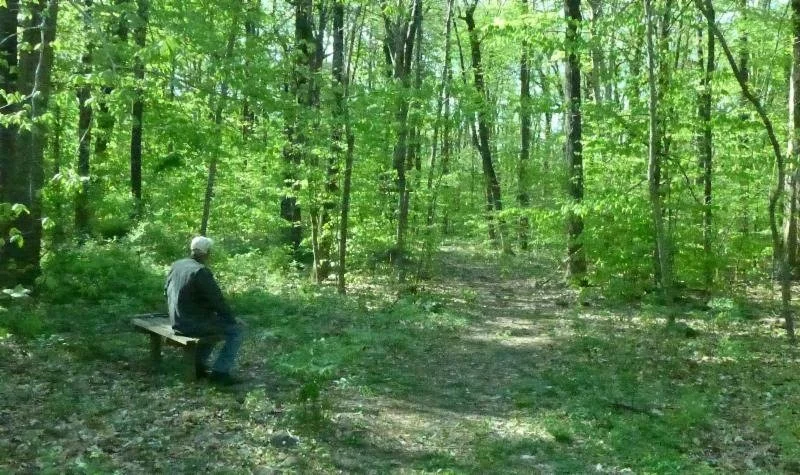
Photo by Jim Amon.
Instead of googling "plant communities" to do a little research on them, I decided to go to a favorite bench on a nature preserve in the Sourlands and just look at a community to see what becomes clear. The first thing I realized is that there are a very large number of plants in an area about the size of a small backyard. I made a list (There were some plants that I could not identify) and found that there were 36 species but many, many specimens of each species. So in addition to the density of the plants, there was a rich diversity of species-a healthy, sustainable trait. It was also clear that the plants were organized in vertical layers. At the ground layer were all the woodland flowers-Bloodroot, May apple, violets, Solomon seal-in addition to seedlings of the trees in the canopy. Above these were the shrubs-Spicebush, Maple-leafed viburnum, and Gray dogwood. Above the shrubs were the understory plants-Flowering dogwood and saplings of the canopy trees. Finally, there were eight species of trees in the canopy layer-a majestic beech was dominant in size (you would have a hard time finding a beech tree that I didn't think of as majestic), and Sassafras were dominant in numbers.
What I could see from my bench was a true garden. These plants had evolved together over millennia and complemented each other in color, texture, and shape.