
Eating the Sourlands
By Jim Amon
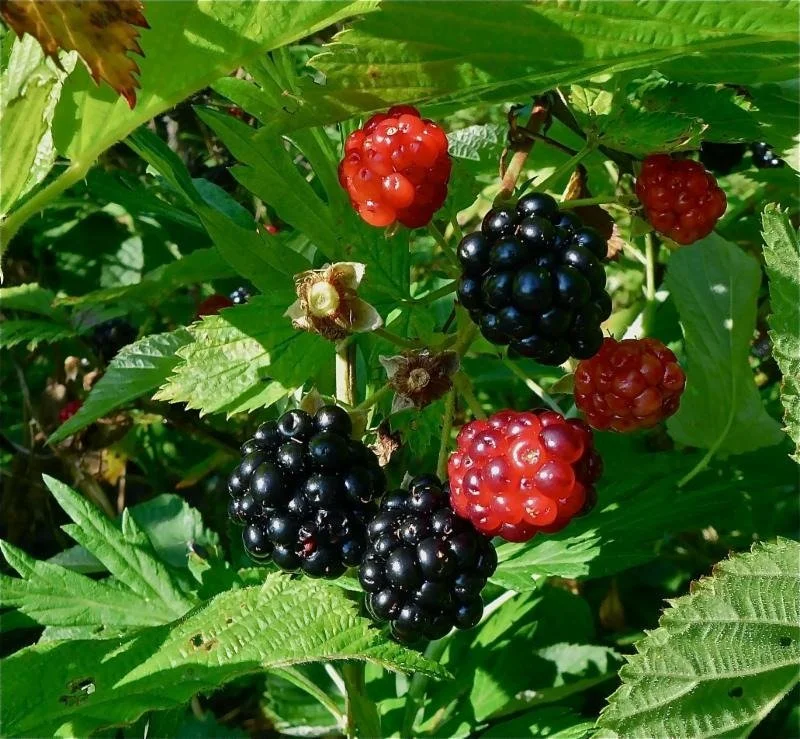
Common Blackberry. Photo by Jim Amon
I was in a field one June with a friend, and I saw some ripe strawberries. I picked a few and, holding out my hand, said, "Here, John, would you like some?" John, who goes into fields as seldom as possible, vigorously shook his head no and responded, "I never eat anything unless it comes from the Safeway." Not many people are that extreme, but a lot of very tasty things are passed up because people have an idea that they probably contain bug urine or something equally distasteful. Native Americans had no such qualms. They supplemented the fish and game they caught with berries, nuts, tubers, roots, seeds, and leaves, and they were so healthy that the 16th-century European explorers who first saw them often remarked on how tall and healthy they were.
Before we go any further on this subject, I must make two caveats. First, if you plan to pick and eat something in the wild, be sure you know what you are doing. There are poisons in some plants. Second, four hundred years ago there were very few people living in this area, and there was a lot of wild landscape-therefore, a lot of edible plants. Today the balance has changed dramatically. Some of the remaining edible plants are scarce or rare, so should not become a snack; even among other, more common plants, some discretion is needed. Go ahead and pick some blackberries or make some sassafras tea, but don't find a patch of wild leeks and dig most of them up, and don't eat all of anything. A good rule of thumb is to pick no more than 10% of common plants.
You could take foraging for food very seriously and pick whole meals or even subsist for days from plants that can be easily found in the Sourlands, but I prefer a more casual approach. I cannot resist the berries. There are strawberries, blackberries, black raspberries, blueberries, and wineberries- all delicious! I have taken home and cracked open Black walnuts and Shagbark hickory nuts. Getting the meat from these nuts is daunting but rewarding. The fruit of Blackhaw viburnum tastes a lot like prunes. Even Autumn olive fruits are often tasty. (If you try one and it is sour, try one from another tree. For some reason they are quite variable.) Morels and Chanterelles, sautéed in butter with a little garlic, are available for the picking and often are restaurant delicacies. When I am hiking, I have found that the new leaves of Greenbrier vines and the leaves of Wood sorrel have a little tang to them that helps to slake my thirst.
Some things are edible, but you have to have a special desire to eat them. Wild grapes are pretty bitter. Crab apples vary a lot, but I have yet to eat one and go back for a second. Like mulberries, crab apples are better for jam than as an impromptu treat. Rose hips are extolled for their vitamin C value-more vitamin C than oranges, they say— but I would much rather get my vitamin C from oranges.
I have often wondered how the Native Americans learned to process plants so that they would be edible. Jack-in-the-pulpit is a good example; its fruit is a tempting and beautiful little red corncob-like cluster, but it is about the worst tasting thing you could ever put in your mouth. The symptoms from eating it include burning in the mouth and throat, diarrhea, nausea and vomiting, swelling of the mouth and tongue, and teary eyes. The leaves are also toxic and are avoided by insects and mammals. But foragers have discovered that if you take Jack-in-the-pulpit root (in the raw, this is the most toxic part of the plant), clean it, slice it thinly, and set the slices out to dry for three months, the slices are sort of like potato chips. How many brave people died or became really sick before that process was discovered?
I like to think that eating native plants is another way of knowing the world that is around me when I hike in the Sourlands. I commonly use the other senses-sight, smell, and touch-to know the landscape, but so far I have only tasted a small portion of what a real forager would eat.