
By Jim Amon
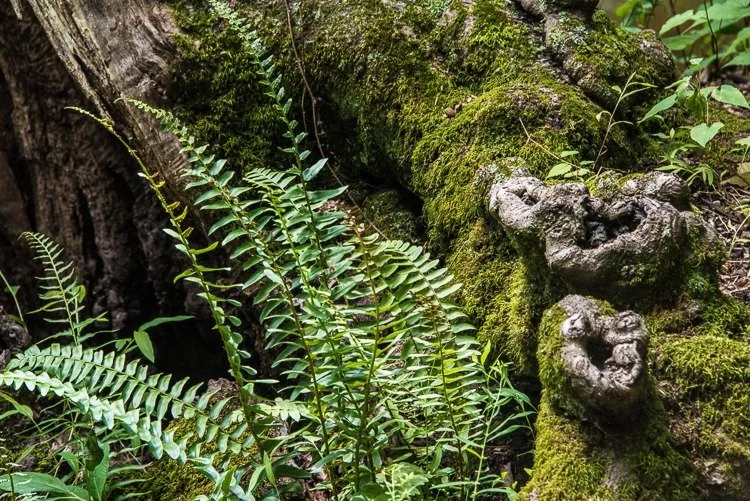
Moss covered tree trunk next to a creek. Photo by Jim Amon.
I am never quite sure where I will end up when I begin to study for one of these essays. I had not gotten very far into a book on mosses, for example, when I read that moss fibers are so indigestible that mosses are not browsed by mammals, with one noted exception. Bears will often eat large quantities of moss before they enter their dens for their long winter sleep. The indigestible moss forms an anal plug, eliminating one issue connected to a several month-long somnolence.
But this is a piece about mosses, not bears. Even though there are about 300 different species of mosses in New Jersey and they have many distinctly different structures, they are seldom seen as anything but a green covering. One reason we don't see them distinctly is that almost none of them have common names and their Latin botanical names are difficult to remember for those of us who don't know Latin. Without names that we can remember it is harder for us to recognize their individuality. If we do look closely we can see that some of the mosses look like flat, miniature spruce trees, some have curly leaves, some have leaves that stick out straight from the stem and some--unless you look with a magnifying glass--do look just like a green cover.
Mosses were the first land plant in the formation of the earth. They evolved from algae that lived in the sea and became able to colonize the land. Their evolution did not include the development of roots that would allow them--like most plants--to draw nutrients and water from the soil. The only way that mosses can obtain life-giving water is directly onto the plant from the air. The mosses' leaves, when they are wet, can then use photosynthesis to convert carbon dioxide from the air into the sugars that nourish them. (Mosses do have root-like mats of rhizomes that provide a little adhesive between the plant and its site but the rhizomes do not grow into the soil.)
In the 350 million years since mosses first colonized land they have retained a special niche in the natural world. They usually cannot live on the floor of a deciduous forest because the falling leaves prevent them from getting any sunlight. But they can thrive on boulders, fallen logs, tree trunks and stumps. It is here, close to the earth, where the temperature is a little warmer and the air is a little moister that mosses thrive. (In a rain forest, where the air is full of water most of the time, mosses can grow on the limbs of trees that are high off the ground.)
There is a world of tiny invertebrates that live only in beds of moss. A piece of moss about the size of an English muffin might typically host 300,000 invertebrates, making the moss a dense and lively habitat. Tiny protozoa live in the rhizome layer, while other invertebrates search about the stalks of the moss for sustenance. There are even invertebrate predators hunting and eating many of the other invertebrates.
Reproduction presents a special set of problems for mosses. They principally reproduce from spores but it is not a simple process of casting spores to the wind and hoping for the best. To create fertile spores a male sperm must reach the egg of a female plant by swimming through a water bridge. The connection is totally random. here is no odor to guide the sperm, nor does the egg emit any kind of noise that would allow the sperm to find it. Since there is no flower, there are no pollinating insects. If there is any break in the water bridge the egg will not be fertilized. If fertilization is successful, special stems that reach above the moss bed grow with bulbs on their ends that contain spores. The spore needs to be above the moss bed because its only way of finding a new site is from wind, and a bed of moss is so dense that there is no wind within it. A moss plant might release hundreds of thousands of spores annually but the spores cannot become new moss plants directly. If a spore lands in a suitably moist location a fragile green network of threads will grow, which in turn--if the site remains moist--will produce moss plants. Not surprisingly, some mosses have given up on sexual reproduction and can reproduce asexually. Any fragment of a moss can be relocated to a suitable habitat and grow into a new patch of moss.
Mosses seem very fragile; they are not rooted to their site, they have very strict habitat needs and they are little. But mosses do have one remarkably tough trait. If moss is established and the moisture stops, the mosses can desiccate but live on. Not just if it doesn't rain for a few weeks or a few months, if mosses are deprived of moisture for decades, they do not die, they simply dry up and wait. Mosses that have sat on researchers' shelves for up to forty years have sprung back to life when a little water was applied to them. For mosses desiccation is not death, it is simply an interruption in their lives.