
Forest Soil
By Jim Amon
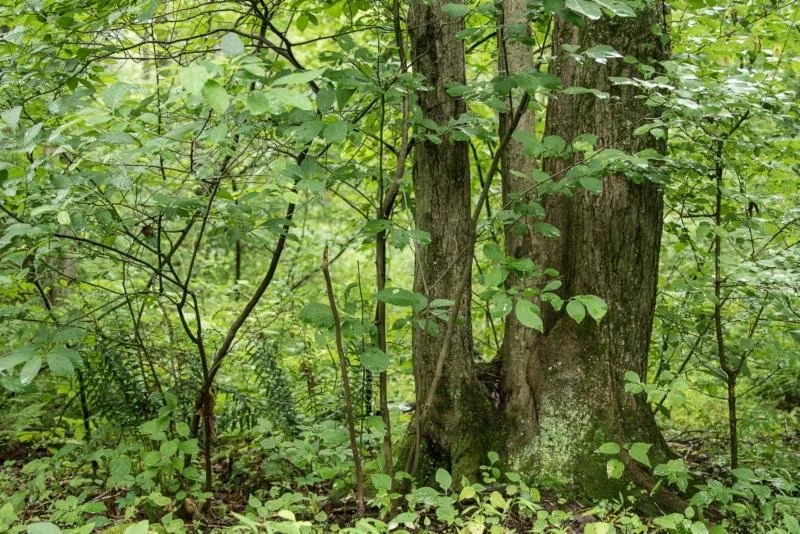
A healthy forest requires a healthy forest soil. Photo by Jim Amon.
Twenty-five years ago I bought a book in a used bookstore entitled FOREST SOILS because this was a subject that I knew little about. Once I got it home, I discovered that it was a textbook written in 1946 and it was dull and didactic. The book went up on my bookshelf, a monument to my good intentions. It stayed there all these years until I took it down again when I started to prepare this essay. I still found it to be insufferably dull, but before I could put it aside again, I read a statement about soils that the author quoted from an 1891 book. The statement is elegant in both style and concept, and it awakened me to the pleasure that I could get from continuing to research this topic.
. . . this mass of debris [forest soil], which at first sight seems a mere rude mingling of unrelated materials, is in truth a well-organized part of nature, which has beautifully varied and adjusted its functions with the forces that operate upon it. Although it is the realm of mediation between the inorganic and the organic kingdom, it is by the variety of its functions more nearly akin to the vital than to the life-less part of the earth. It is reasonable to compare its operations to those of the plants which it sustains, for in both there are the harmonious functions which lead matter from its primitive condition to the higher estate of organic existence.
Think of that! Soil is not just the hard stuff we walk on or the substance that trees somehow grow from! It is more akin to the plants growing in it than it is to a stone. It is almost alive! Well, it is not alive, but it is highly complex and contains an amazing amount of material that is alive. Recently, a soil scientist in upstate New York removed a one-inch-thick section of forest soil that was one square foot in area and found 1,356 living creatures, 7 billion bacteria, and many millions of fungi, algae, and protozoa. (How, I wonder, did he count the 7 billion bacteria? Oh well, even if he is off by a few million, his finding is impressive.)
It may seem like there could be no room in soil for anything else, but even adding other organic material--like decomposed leaves, seeds, nuts, bark, twigs and limbs--the organic content of forest soil only comprises about 5% of the total. The largest component of forest soil is the minerals--sand, silt, clay. Water is usually the second biggest component, but the amount of water depends on many factors. (How much and how recently has it rained? Lowlands have more water than uplands or slopes. Water drains right through sandy soil; it cannot easily penetrate clayey soil, and it bonds with humus.) Soils also contain gases. Oxygen, carbon dioxide, and nitrogen are present and are essential for plants to grow.
The upper layers of forest soils contain a network of mycorrhizal fungi, a fungus that is so interesting that it borders on the miraculous. This fungal network surrounds the roots of trees and shrubs and grows into them. From the roots, it draws sugars that are made from the photosynthesis taking place in the plant's canopy. In exchange for this sugar, it facilitates the passage of water, gases, and nutrients from the surrounding soil into the roots, which then transmit them to the rest of the plant.
Forest soil is also akin to the plants it supports because, like them, it is changing continuously. It is eroded by wind and water. New material is added to it from the organic material that falls to the forest floor and is broken down by various agents of decomposition. Stones slowly weather and add new minerals to the soil. As water seeps through the soil, it leaches minerals and other nutrients from the upper levels of the soil. Roots take nutrients from the soil. Even a lightning strike can have an effect. Lightning separates nitrogen atoms in the air, and then the nitrogen falls to the earth, enriching the soil.
Forest soils are different from agricultural or residential soils because they have not been plowed, compacted by machinery, or from consistent human activity. Nor have they had herbicides, pesticides, and fertilizing chemicals poured on them. Forest soil needs to be seen as a precious natural resource, just as we regard the forest itself.