
Seeing the Sourlands: Woodpeckers
By Jim Amon
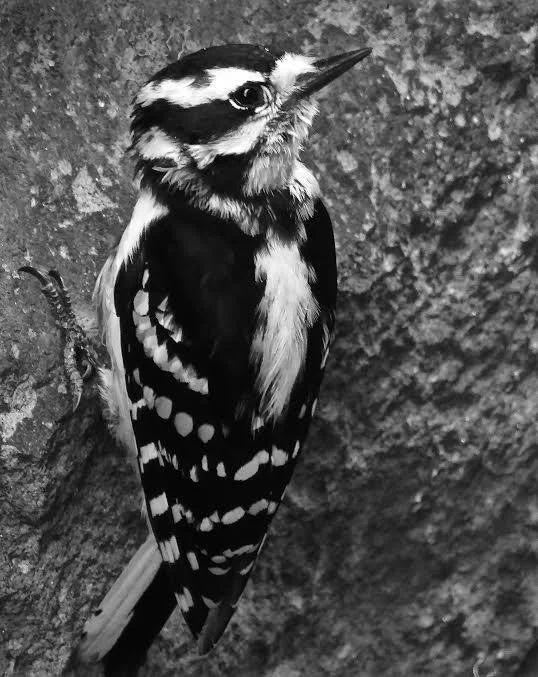
Female Downy Woodpecker
How do they do it? How can woodpeckers bang their heads against trees hundreds of times with no apparent bad effect? Scientists all over the glob have asked this same question and they have concluded that there are a number of reasons why woodpeckers can do what humans could never do.
First, they have found that woodpecker heads are different from human heads in a number of structural ways. Human brains fit loosely inside human skulls but woodpecker brains fit tightly inside a woodpecker skull so there is no room for the brain to move around and knock against the inside of the skull the way a human brain would. Further, while a human brain is roundish, woodpecker brains are long and thin, spreading the force of each peck over a wider area.
Further, both woodpeckers and humans have a bone that is called hyoid, but they are quite different. The human hyoid bone is located just above the Adam’s apple and serves as a rigid platform to support the tongue. The woodpecker hyoid bone, in contrast, loops around the whole skull. It starts at the underside of the bird’s beak, splits into two pieces and makes a full loop through the nostrils, proceeds under and around the back of its skull, then goes over the top of the head where the two pieces meet at the forehead. The woodpecker hyoid bone acts like a safety harness for the head. Woodpeckers also have plate-like bones with a spongy structure located in different parts of their skulls, helping to distribute the incoming force. A further structural explanation is that a woodpecker’s upper beak is slightly longer than the lower beak. This asymmetry causes the force to be transferred from the upper to the lower beak and that somewhat lowers the force before it gets to the head.
Slow motion studies of woodpeckers pecking show that the woodpeckers are continuously moving their heads so that each peck is at a slightly different angle to the tree. This movement minimizes the number of times in a row that the force is reaching the woodpecker head in exactly the same way. Studies have also shown that as it pecks a woodpecker’s brain gets warmer. They periodically stop to allow their brains to cool.
The other question that I brought to my research on woodpeckers is, why do they peck? I got three answers. First, they peck to uncover insects, insect eggs and larvae, and other invertebrates, which they eat. Second, they make cavities that can serve as their nesting sites and as winter roosting sites. (When abandoned, these cavities often become homes for cavity-nesting birds that cannot make their own cavities. Nuthatches, wrens, bluebirds and flycatchers take up residence when the woodpecker leaves.) Third, they peck to establish territory or to attract a mate. So when a woodpecker starts banging away on your house’s downspout it is not crazy, it has found a very resonant place from which to tell other woodpeckers that this area is his.